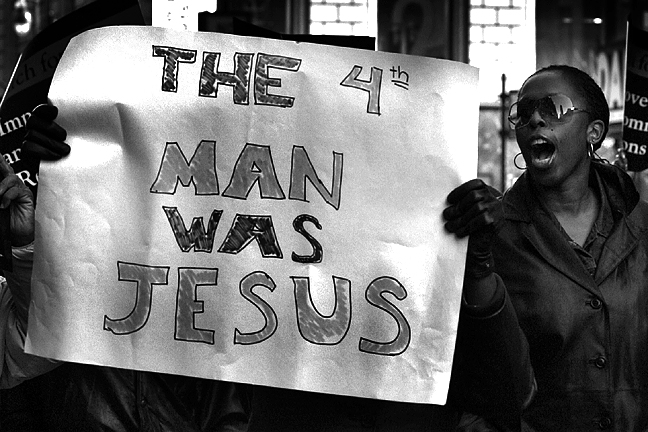
 The photograph above wonders aloud about the identity of the alleged "4th man" that police said was at the scene the night that Sean Bell was shot. Bell was unarmed--and yet something happened to cause the detectives to fire at him 50 times. I was talking with a black colleague on Saturday about the "innocent" verdict in the detectives' trial.
As we talked, I saw--and heard--the deep sadness in my colleague. It came through when he started to talk about how, as a parent, he has to advise and direct his own teenage son about what to do and what not to do when he encounters the police. Being young and black is to be branded as a violent threat. There is no escaping the brand. You can't cover it or hide it. It follows you everywhere you go. It is in everything you do.
We wondered aloud why young black men choose the "thug" lifestyle--entertaining the notion that black men bring the violence on themselves through their choices. And it is clear that the wrenching dilemma is that black men do commit a disproportionately high percentage of violent crimes in New York AND that they are far too frequently victimized by law enforcement.
Being black puts a person at a greater risk of committing a violent crime and being victimized by one.
What will we do so that this is no longer true?
***
Another article from the newspaper shows how hatred and mistrust of Muslims still bubbles just below the surface of polite "tolerance" in New York. The principal of a new New York City school was fired--for no cause--after a loose network of people with a strong anti-Muslim bias, fueled by the enlightened editors at the New York Post, determined that a school led by a Muslim and teaching Arabic as a second language was a threat to the safety of our city. Read the long, chilling article here.
Sorry, David, I have to disagree with the first part of your post.
ReplyDeleteCasting excessive force on the part of policemen as a racial issue does us all a disservice.
My brother, Alexander Barrack, was killed in an excessive force situation on February 13, 1979. Years before any of the celebrated "racial" cases. My brother's skin was as light as mine. My brother was also no angel. But it was not necessary for the police to break down the door to his apartment, find where he was hiding in fear, and pump his body through with nine bullets to his chest.
I found out about my own brother's death through a radio report. My parents learned of their own son's death through a radio report. It was a top televison story, too.
Realizing what the publicity could do to the rest of their lives, my parents chose not to speak out. Living with the silence was unbearable for me
But, only across the decades does the full impact of that silence torture me. How different would our city be now, had a white Jewish family living in Staten Island spoken out about losing a family member to police over-reaction? Decades ago?
Since my parents' deaths, I have spoken out. Most recently at a special Presbytery of New York committee on the Bell shooting. Many people don't want to hear it -they are too invested in racial polarization now. But. bullets don't care what color your skin is. They are deadly to any of us when discharged by undisciplined hands.
Ula, thank you for sharing your own story. You are right--it does a disservice to Alexander and the many other non-black victims to cast the issue of police violence strictly as a racial issue.
ReplyDeleteUnjust violence does not spare non-blacks.
And yet, the statistics themselves force us to draw race into the conversation. Even the justice department's own statistics show that blacks are twice as likely to suffer violence in exchanges with police than whites.
Black people commit more violent crimes than they otherwise should--and they are also disproportionately the victim of crimes by law enforcement.
I do think white people have an obligation to support our black sisters and brothers in protesting police violence AND in challenging the "thug" culture's reliance on violence as a means of legitimation AND in continuing to ask aloud why we still abide by ghettos that breed violence.
Wow. This is such a powerful discussion. I am so glad this sort of dialouge is happening. There is truth to both sides of this issue. Blacks are racially profiled, and many white people are abused by the law as well. It is not an issue of one or the other, both happen. As to a resolution? I think sadly rascism is not going to end anytime soon. Hatred of "the other" goes back to biblical times, and is the human condition. We can thankfully enact laws to prevent malicious racist people, but you cannot change someone's heart with a law. It saddens my heart to come to grips with that fact. Although looking at the rainbow of colors in the Marble community does give me hope.
ReplyDelete